By Taghreed Saadeh
With the start of work by the Palestinian National Committee for the Administration of the Gaza Strip, it can be said that Hamas’s rule over the enclave has effectively come to an end. This rule, which lasted nearly two decades, brought Gaza nothing but the reoccupation, widespread destruction, and a constant threat of forced displacement, in addition to governing the strip through iron and fire.
This rule was carefully arranged with the support of external actors and under implicit approval from the occupation, serving as a tool to deepen the Palestinian division and prevent the establishment of an independent Palestinian state. Twenty years of isolating Gaza from its national context and separating it from the West Bank have exacted a heavy price from the Palestinian cause and the Palestinian people, most severely in Gaza itself.
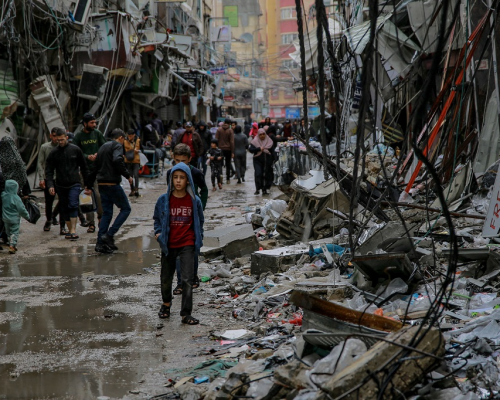
By all measures, the formation of the National Committee opens the door to reconstruction and to rescuing Gaza’s residents, who have endured more than two years of devastating war, suffocating siege, deprivation, displacement, and severe food insecurity as a result of the occupation’s policies.
According to statements made by the committee’s head, Ali Shaath, in a radio interview two days ago, the committee will implement projects previously prepared by Palestinian Authority ministries and approved at both the Arab and international levels. Shaath confirmed that the committee is funded by the World Bank and was established by an international decision, while the issue of disarming Hamas falls under the mandate of the “Peace Council.”
Contrary to what Hamas-affiliated media outlets claim, the committee’s mission is primarily administrative and humanitarian. Its goal is to pull the Palestinian people in Gaza out of an unprecedented humanitarian catastrophe, one that has brought the occupation back into the heart of the strip.
Hamas’s attack on the committee, despite having announced its approval of it during the Cairo meeting, falls within the framework of political maneuvering and evasion of the obligation to hand over weapons. Those weapons formed the foundation of Hamas’s rule in Gaza, yet they brought the people nothing but destruction, at the cost of Palestinian blood and the future of their national cause.
In this context, the U.S. president stated today that his country, with the support of Egypt, Turkey, and Qatar, will ensure the achievement of a comprehensive agreement to disarm Hamas and destroy the tunnels, adding: “Hamas can do this the easy way or the hard way.”
As usual, Hamas continues to stall. Its leaders have stated in TV interviews over the past two days that no final agreement has yet been reached regarding the handover of weapons, despite leaks from figures close to the movement suggesting an intention to relinquish them. The movement appears to realize that its weapons are its sole source of legitimacy, and that giving them up would mean the end of its role both as a governing authority and as a movement whose popular support in Gaza has all but vanished.
What is now clear is that Hamas’s rule over Gaza has ended, with no return, and that the temporary National Committee represents a preparatory step toward the Palestinian Authority assuming responsibility for the strip.
The National Committee for the Administration of Gaza held its first meeting in Cairo yesterday, with the participation of its fifteen members. The committee is headed by Ali Shaath, a former Palestinian Authority minister, while Nikolay Mladenov oversees its work on behalf of the Peace Council.
What matters now is accelerating reconstruction, strengthening the resilience of Palestinians in Gaza, and blocking the occupation’s plans aimed at forcibly displacing the Palestinian people from their land.
 99 Total Count