By Taghreed Saadeh
Analysts and defenders of Hamas often repeat a question that has become worn-out on television screens, Who will protect the families of Hamas members and their children if the group surrenders its weapons, given the presence of gangs supported by the occupation? After all that Gaza has endured, this question is no longer innocent or legitimate. The reality shows that Hamas’ weapons have never been a tool to protect the Palestinian community. On the contrary, they have often been used as an instrument of internal repression, targeting political opponents, intimidating Palestinian families, and justifying killings under the accusation of “collaboration”, an accusation both convenient and dangerous under the occupation.
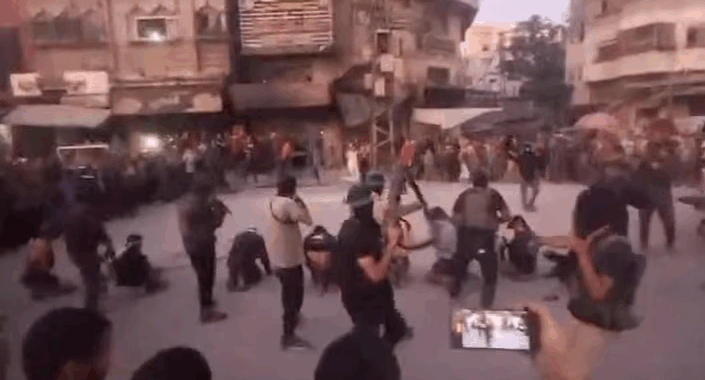
Dozens of Palestinian families found no one to defend them; instead, they were subjected to public shaming and accusations of betrayal, and they were killed twice, once by Hamas’ weapons, and once through incendiary rhetoric. This is how Hamas ruled Gaza without oversight or accountability, allowing it to continue using its weapons against the Palestinian community instead of protecting it. Moreover, following the ceasefire with the occupation last October, Hamas took the initiative to carry out dozens of executions against its rivals.
Today, Hamas’ weapons have become the central obstacle to rebuilding Gaza. Calls for their surrender are not an Israeli demand, as the movement claims, but an international requirement enforced by donor countries, the international community, and both the Arab and Islamic countries.
Over twenty years, Hamas has politically and socially hijacked Gaza, entrenching a dangerous vertical division within Palestinian society, either you are with Hamas, or you are labeled a collaborator with the occupation. This destructive dichotomy has not only torn the social fabric but also inflicted deep and lasting harm on the Palestinian community effects that persist to this day.
Hamas understands that surrendering its weapons would mark the end of its rule as an armed organization. That is why it maneuvers carefully. Yet this is not a defense of national struggle; it is a bid to preserve its organizational survival. The movement claims that disarming would end resistance, a narrative that contradicts Palestinian history, which shows that Palestinians have fought and achieved significant victories without monopolizing weapons or hijacking national decision-making. Even the claim that disarmament would create a security vacuum is invalid, as a Palestinian committee currently manages the affairs of the Gaza Strip.
The weapons with which Hamas has ruled Gaza in the name of “resistance” have not protected the people, nor deterred the occupation. Instead, they have repeatedly dragged the Gaza Strip into wars with no political horizon and no humanitarian consideration, and have been a leading cause of thousands of Palestinian deaths, the destruction of Gaza, and the deepening of its people’s suffering. The lack of accountability is the root cause of this disaster. The movement has been able to raise the banner of liberation while its policies perpetuate tragedy and provide the occupation with additional justifications to tighten its siege and aggression. Today, the continued possession of weapons by Hamas is a pretext to delay reconstruction and an open path toward the potential displacement of Palestinians, the gravest threat to the Palestinian cause at this stage.
The presence of an armed Hamas has become the very argument that Netanyahu and his government rely on to maintain the status quo. Meanwhile, the movement shows little concern for the welfare of the people, focusing instead on preserving itself as an armed organization awaiting a shift in regional and international circumstances for recognition, even if the price is more Palestinian blood or the execution of displacement plans.
After all this, Palestinians have the right to ask, What has Hamas gained from twenty years of division, except to entrench its rule, distort the truth, separate Gaza from the West Bank, and sabotage the Palestinian state project? What has it achieved besides political and moral defeat, leaving thousands of martyrs, a fractured society, and a cause mired in complexity?
Surrendering Hamas’ weapons is no longer a political option to be postponed. It is a national and moral imperative, one that opens the door to saving what remains of Gaza, stopping the bloodshed, and preventing displacement. Any further delay will be paid for by the Palestinian people alone, and then neither slogans nor rhetoric will protect Hamas from the judgment of history or of the people themselves.
 85 Total Count