New York – Zaytoun News
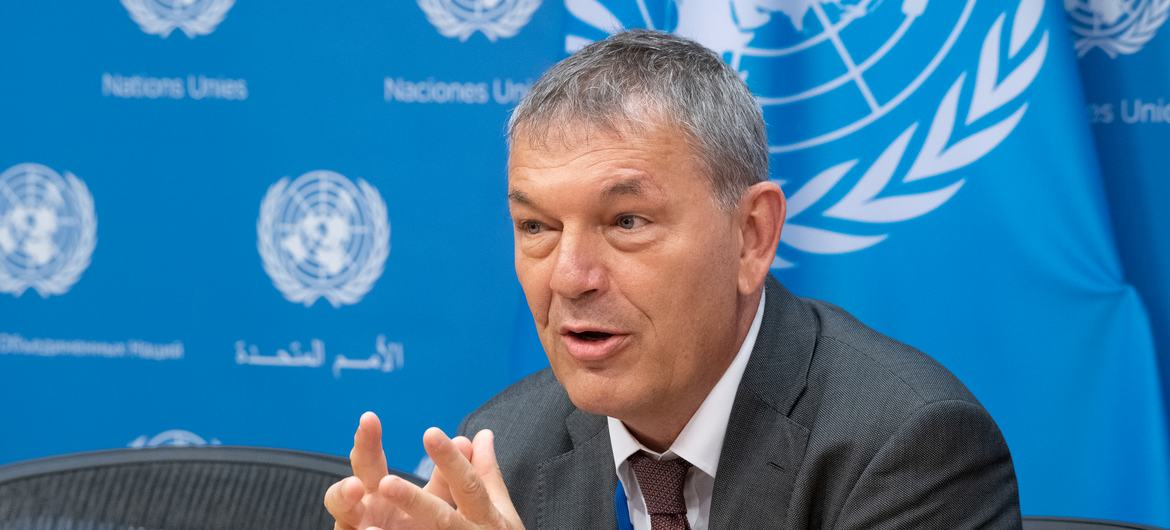
Philippe Lazzarini, Commissioner-General of the United Nations Relief and Works Agency for Palestine Refugees (UNRWA), warned that approximately 1.6 million Palestinians in the Gaza Strip continue to suffer from acute food insecurity, despite the ceasefire that came into effect in October 2025.
Lazzarini stressed that the relative improvement in security conditions has not translated into a tangible improvement in people’s daily lives, as the majority of families remain unable to secure their basic food needs on a regular basis and continue to rely almost entirely on humanitarian assistance.
He explained that acute food insecurity means millions of people face persistent difficulties in accessing sufficient and nutritious food. Many families have been forced to reduce the number of daily meals or rely on limited types of food lacking adequate nutritional value, exacerbating the risks of malnutrition—particularly among children, pregnant women, and breastfeeding mothers.
Lazzarini noted that UNRWA already has substantial food stocks, including food parcels sufficient for more than one million people, as well as flour supplies enough to cover the needs of the entire population of the Gaza Strip. However, these supplies are stored outside Gaza and cannot be delivered at the required scale due to restrictions at border crossings and access constraints. He confirmed that UNRWA currently has food parcels sufficient for 1.1 million people and flour enough for the entire population of Gaza, awaiting permission to enter the territory.
Lazzarini’s remarks are consistent with assessments by the Integrated Food Security Phase Classification (IPC), a United Nations–affiliated monitoring system, which reported that Gaza is no longer officially classified as being in famine. Nevertheless, the situation remains at an acute emergency level. According to these assessments, most of the population is living under conditions described as a “food crisis,” meaning that any reduction in aid flows or renewed escalation could quickly push the situation back to more dangerous levels.
UN reports indicate that the groups most affected by the food crisis are children under the age of five, who face increasing risks of acute malnutrition, as well as pregnant and breastfeeding women, the elderly, and the sick. In many cases, families are forced to make harsh choices, such as prioritizing children’s meals over adults’ or skipping entire meals to reduce expenses, leaving long-term health consequences.
In this context, the United Nations and international relief agencies—most notably the World Food Programme and UNRWA—have emphasized that improving food security in Gaza requires the regular and sufficient opening of border crossings, the rapid entry of food, medical supplies, and fuel, and the guarantee of safe and unhindered movement for humanitarian workers inside the territory. They also warned that any renewed disruption to relief operations could lead to a rapid deterioration in food security and undermine efforts to prevent a return to famine.
 50 Total Count