By Taghreed Saadeh
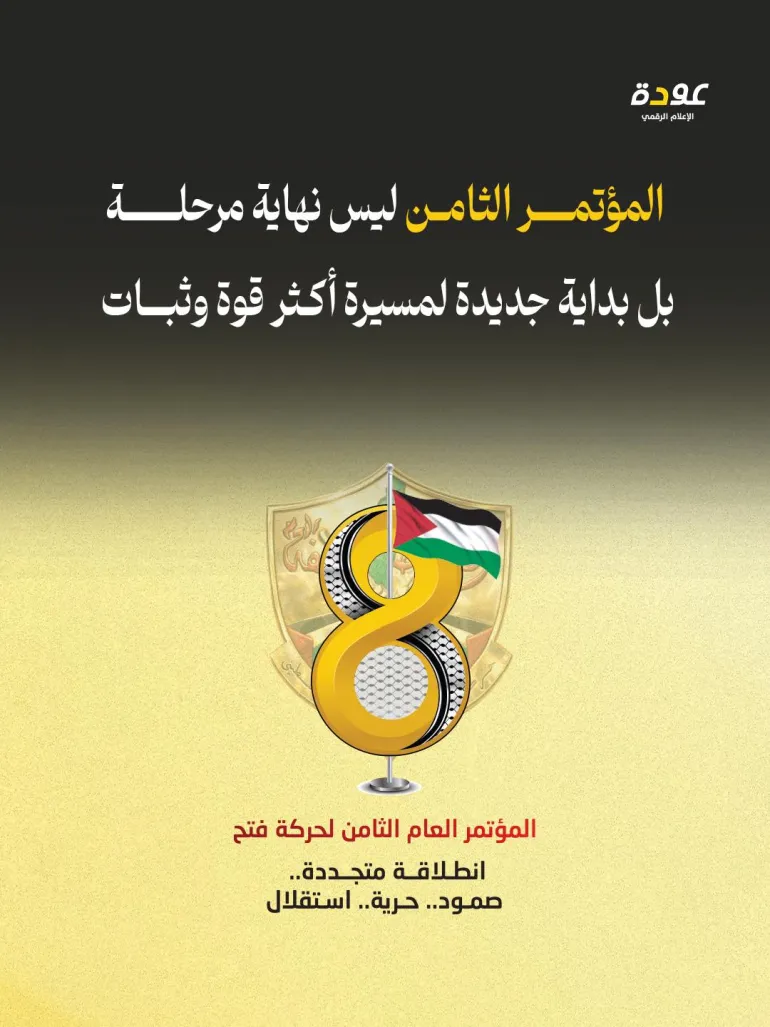
The Fatah movement, the pioneer of Palestinian national struggle, succeeded in holding its eighth conference despite numerous challenges that nearly obstructed its convening, particularly the difficulty of gathering participants in one location. As a result, sessions were distributed between Ramallah, Gaza, Beirut, and Cairo.
The conference witnessed the rise of new figures within the movement’s leadership, most notably Major General Majed Faraj, head of the General Intelligence Service; former prisoners Zakaria Zubeidi and Tayseer Al-Bardini; Yasser Abbas, son of Palestinian President Mahmoud Abbas; and Dr. Laila Ghannam, Governor of Ramallah, whose broad popularity was reflected in her third place ranking, ahead of several historic Fatah figures. Also elected was former prisoner Adnan Ghaith of Jerusale), marking an important return of direct Jerusalem representation to Fatah’s Central Committee.
The introduction of new faces signals a renewed path for the movement, one that remains committed to Fatah’s traditional political line while introducing new mechanisms of action and restoring the movement’s historic standing within Palestinian society ahead of upcoming parliamentary and presidential elections.
Palestinian President and Fatah Chairman Mahmoud Abbas outlined the movement’s political program during his opening speech at the conference, after being unanimously reelected as leader of Fatah. Central to his address was the call for an end to the war in Gaza and the reconstruction of the Strip within the framework of Palestinian territorial unity. He reaffirmed support for establishing an independent Palestinian state on the 1967 borders with East Jerusalem as its capital, in accordance with international legitimacy and the two-state solution.
Abbas also stressed the importance of ending Palestinian internal division under the umbrella of the Palestine Liberation Organization, adopting peaceful popular resistance, and rejecting settlement expansion, annexation, and unilateral Israeli measures. He further emphasized strengthening international diplomatic efforts, securing wider recognition of the State of Palestine, implementing political and administrative reforms, promoting democracy and elections, preserving refugee rights, protecting the role of UNRWA, and pursuing comprehensive regional peace based on ending the occupation and achieving security and stability for all.
According to official Fatah figures, 2,643 members participated in the conference, with only around 136 abstaining from voting. Gaza and Lebanon recorded the highest participation rates, with only four members absent from voting in Gaza and just two in Beirut, bringing overall voter participation to 94.65%.
One of the conference’s most notable features was the strong representation of prisoners, reflecting broad consensus within Fatah around the symbolic stature of Marwan Barghouti. The election of Tayseer Al-Bardini from Gaza and Zakaria Zubeidi , known for the famous Gilboa prison escape, alongside former prisoner Adnan Ghaith from Jerusalem underscored the movement’s continued focus on the issues of prisoners and Jerusalem.
Women also strengthened their presence within the Central Committee through the election of Ramallah Governor Laila Ghannam, who enjoys significant support within the movement. Dalal Salameh, originally from Balata refugee camp and one of Fatah’s longstanding figures, also retained her seat on the committee, reflecting the continued role of women in decision-making positions within the movement.
Regarding Gaza, it became increasingly clear that Fatah is seeking to reinforce the Strip’s representation within its political and leadership structures, whether through the advancement of Gazan figures to senior positions or through repeated political emphasis on the unity of Palestinian territories and rejection of any separation between Gaza and the West Bank. The reconstruction of Gaza was also placed at the forefront of the movement’s political priorities.
Among the election results was the appointment of Yasser Abbas to the Central Committee. Abbas, a businessman and economist who served for years as a representative of the president, has largely worked outside Palestine and historically maintained a limited organizational role within Fatah. During his campaign, however, he stressed that he is primarily an economic figure with a reform-oriented economic plan, insisting he has no political ambitions and no interest in entering politics.
Fatah sources indicated that the economic proposals he presented impressed many conference participants, helping facilitate his election and countering accusations that he was being groomed to politically inherit his father. This was particularly significant given the presence of influential leaders within the movement who are widely viewed as potential successors.
The same sources stated that when Yasser Abbas informed President Mahmoud Abbas of his intention to run, the president told his son he would neither support him nor play any role in securing his place on the Central Committee. Consequently, Yasser Abbas relied on his own efforts, personally contacting conference members in Beirut, Cairo, and Ramallah, and holding phone conversations with Fatah members in Gaza. According to those close to him, his success was therefore the result of personal outreach rather than presidential influence.
Despite difficult circumstances, Fatah succeeded in holding its conference and electing a new leadership while preserving its core political program. At the same time, the movement demonstrated its ability to inject new blood into its ranks within a clearly defined current committed to Fatah’s principles and legacy, in preparation for upcoming political milestones, most notably the Palestinian National Council elections scheduled for next November.
These elections come within the framework of a broader vision aimed at renewing legitimacy and revitalizing the institutions of the Palestine Liberation Organization, alongside legal reforms and the drafting of a new constitution for the State of Palestine, paving the way for future general and presidential elections.
 81 Total Count