
By Taghreed Saadeh
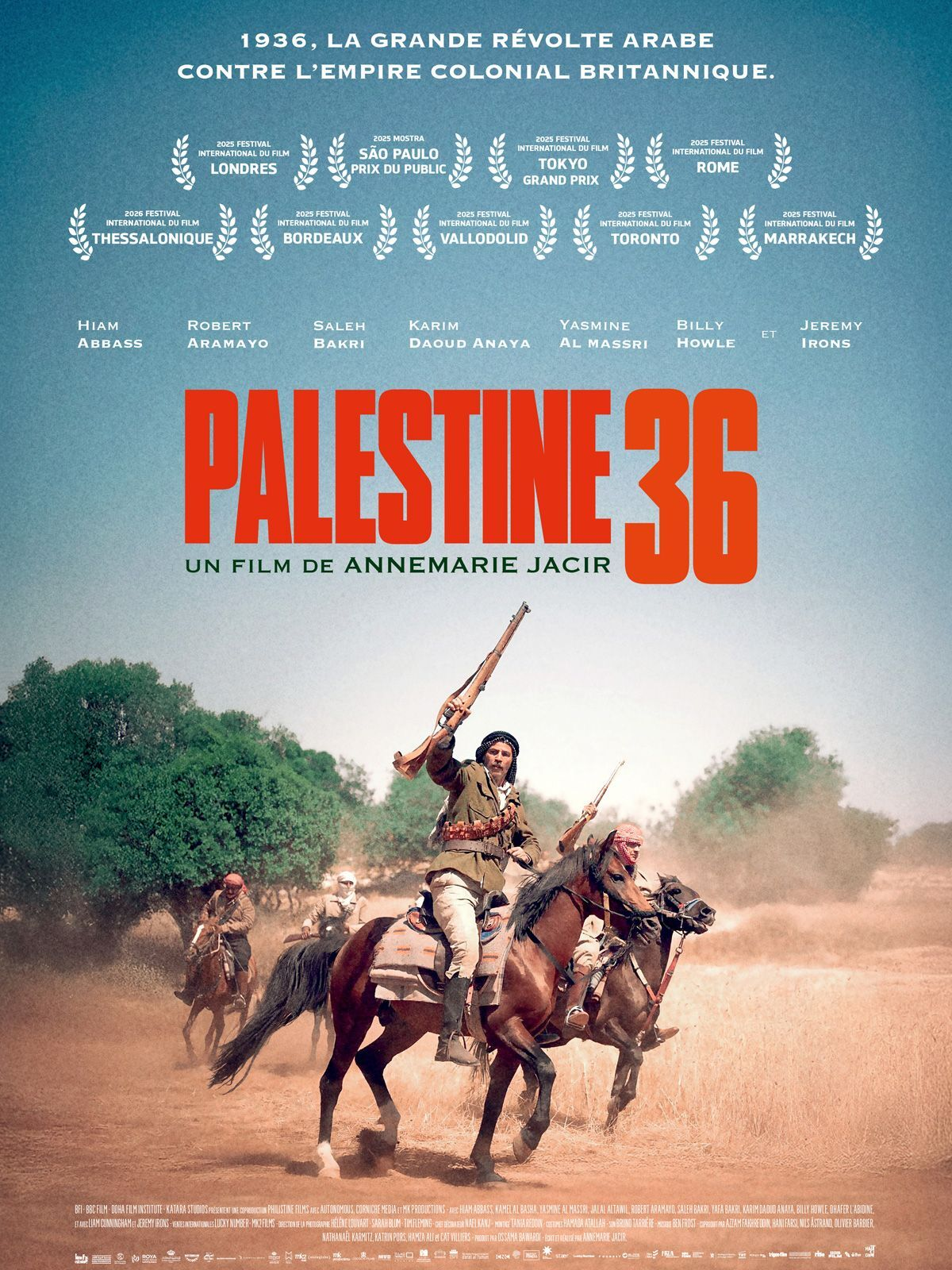
The ongoing debate surrounding the film Palestine 36 by Palestinian director Anne-Marie Jacir, which recently made the Oscar shortlist, has reignited discussions sparked by novelist Ibrahim Nasrallah’s public statement on social media. In his statement, Nasrallah suggested that the film may have drawn from his novel Time of White Horses, a work that explored a broader historical era. This controversy has once again raised questions about intellectual property in historical works, particularly those dealing with Palestinian history.
At the heart of the discussion lies the question of where the boundaries of similarity begin and end in literary and cinematic works set within the same historical period. Is such Similarity evidence of direct adaptation from a previous work, or is it the natural result of relying on shared historical sources and a collective memory shaped through oral histories, books, testimonies, and historical studies?
Fundamentally, history cannot be treated as property to be owned. Major events such as revolutions, displacement, and social transformations do not belong to a single writer or artistic work; they are part of a collective memory documented through books, testimonies, and oral narratives. Therefore, the recurrence of familiar characters — the peasant, the resistance fighter, the refugee, or the urban community — is entirely expected in works dealing with the Palestinian experience, because they emerge from the same historical reality.
In this context, similarities between historical works become less an indication of plagiarism and more a natural consequence of shared sources. Palestinian history, with its recurring human and social details, inevitably produces narratives that resemble one another in their broader features, even when their artistic treatment differs significantly.
Perhaps the clearest example of this idea, that similarities arise from collective memory, can be seen in the parallels between Palestine 36 and the acclaimed series Al-Taghriba Al-Filistiniya (The Palestinian Exodus), written by renowned screenwriter Walid Saif, particularly in their portrayal of the 1936 Palestinian revolt. There are indeed overlapping atmospheres, themes, and details in the depiction of Palestinian peasants, social transformations, and people’s relationship to land and resistance. Yet no one accused Jacir of “stealing” Al-Taghriba Al-Filistiniya, because it is widely understood that Walid Saif himself did not claim Palestinian history as private property; rather, he artistically reinterpreted it through oral history, collective narratives, and inherited testimonies.
Palestinian writer Samir Al-Barqawi addressed this idea in a Facebook post commenting on the controversy. He noted that certain character archetypes naturally recur in narratives, the revolutionary, the collaborator, the rural elite, the imam, the intelligent child, and the patient mother. Their repetition does not mean one writer stole them from another, because these figures are part of Palestinian historical and human reality, not the invention of any individual author.
Al-Barqawi also pointed out that many international critics have long discussed the limited number of fundamental human plots. He referenced critic Christopher Booker, who argued that major stories can be reduced to a small number of basic plot structures, as well as French critic Georges Polti, who identified the “Thirty-Six Dramatic Situations” as the foundational templates of human drama. Such references reinforce the idea that similarities in themes and archetypal characters are natural in literature and cannot alone be considered evidence of plagiarism or unauthorized adaptation.
Ironically, Ibrahim Nasrallah himself has previously faced critical observations regarding possible influences from international films and novels on some of his works. Palestinian critic Adel Al-Usta questioned whether certain novels by Nasrallah reflected cinematic or literary influences, referring to works such as Awo and Guardian of the Lost City, as well as articles comparing some of Nasrallah’s writings to internationally known films. Al-Usta also referred to Nasrallah’s own memoir, My Childhood Until Now, in which the novelist openly discussed the impact of what he read and watched during his formative years, particularly after reading Ray Bradbury’s Fahrenheit 451. Al-Usta considered this a natural example of how literature and cinema shape any writer’s creative development.
In his article, Al-Usta further mentioned that during a conversation with an active critic, whom he did not name, he was told that Nasrallah’s novel Time of White Horses itself may have been influenced by a film titled Time of the White Horses, which had reportedly been screened before the novel was written, during a period when Nasrallah was working at the Abdul Mohsen Al-Qattan Foundation (Shoman). Al-Usta emphasized, however, that such claims require careful scholarly research and verification before they can be accepted or asserted with certainty.
Ultimately, history belongs to everyone. The true value of any artistic work lies not in claiming ownership over history, but in its ability to reinterpret that history through a unique human and creative vision.
 42 Total Count