By Taghreed Saadeh
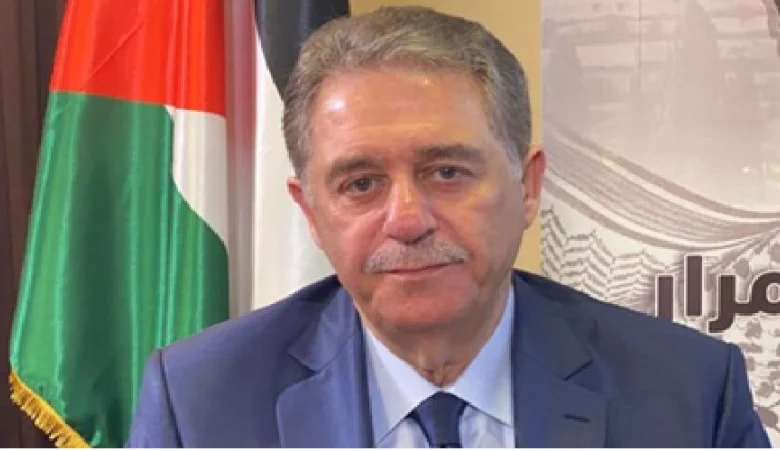
A Lebanese court’s decision to reissue an in person arrest warrant against former Palestinian ambassador to Lebanon Ashraf Dabbour has reopened one of the most sensitive files within the Palestinian community in Lebanon. Dabbour is now wanted by the Palestinian Authority over allegations involving corruption, embezzlement, and mismanagement of Palestine Liberation Organization (PLO) institutions during his term as ambassador.
Lebanese security forces first detained Dabbour in April, immediately upon his arrival at Beirut airport, in implementation of an arrest warrant issued by the Palestinian judiciary. The Lebanese judiciary subsequently issued an in person arrest warrant against him on Monday as part of ongoing proceedings to hand him over to the Palestinian Authority.
Ashraf Dabbour returned from Tunisia to the Palestinian territories at the end of 1994, following the establishment of the Palestinian Authority. He worked as a secretary in the office of the late Palestinian President Yasser Arafat in Ramallah and Gaza, and remained in the position after Arafat’s death, when Mahmoud Abbas assumed the presidency of the Palestinian Authority, until 2007.
That same year, Dabbour moved to Lebanon as deputy to the Palestinian ambassador at the time, Abbas Zaki, and later served under his successor, Abdullah Abdullah. He was appointed ambassador in 2012 and remained in the post until President Mahmoud Abbas dismissed him in 2025.
According to senior Palestinian security sources who spoke to Zaytoun News, the dispute with Dabbour did not begin over the issue of handing over Palestinian weapons in Lebanon, as has been reported, but rather after official Palestinian committees began reviewing the situation in Lebanon and the PLO institutions operating there.
The source said that security and administrative delegations from Ramallah began visiting Lebanon to follow up on the implementation of Palestinian-Lebanese understandings concerning the regulation of weapons inside the refugee camps. During those visits, he said, “files came to light that the Palestinian leadership had not previously been aware of.”
The source added that an agreement to regulate and restrict weapons is in place between the Palestinian and Lebanese presidents, and that Dabbour sought to portray himself publicly as an opponent of this process, although the weapons issue was not the root of the dispute.
The Palestinian security official said one of the leadership’s main concerns was that Dabbour “acted unilaterally in everything related to the Lebanese arena,” claiming that he had built a parallel network of institutions alongside the official PLO institutions.
According to the source, these institutions included healthcare bodies, civil defense organizations, and media outlets, including a television station and a radio station broadcasting from Lebanon, as well as healthcare and social-care institutions. Their operation, he said, required substantial funding whose sources were not clearly known to the official Palestinian authorities.
The Palestinian leadership subsequently began restoring these institutions to their official chains of authority. The healthcare association, for example, was returned to the Palestinian Red Crescent, while the PLO-affiliated media institutions were reorganized.
The source said a review of financial records revealed, according to Palestinian investigations, irregularities in payment and funding procedures. These allegedly included employees signing payroll sheets or financial statements showing salaries or payments lower than the amounts they actually received.
The Palestinian Authority later decided to channel funding directly to the relevant institutions rather than through the ambassador or his office, with the aim of strengthening financial oversight and ensuring that funds reached their intended recipients.
The source also noted that substantial budgets had been allocated during the COVID-19 pandemic to support the Palestinian health sector in Lebanon and Syria. However, all disbursements were processed through the ambassador’s office, prompting a subsequent review of the funding mechanisms.
Another highly controversial issue concerns the restructuring of the Palestinian National Security Forces in Lebanon.
The source said the Palestinian Authority conducted a comprehensive review of personnel records and found names of individuals who were not actually members of the National Security Forces, including people who had exceeded the legal age limit and others of different nationalities, as well as individuals allegedly affiliated with extremist groups.
He explained that around 2,000 people were dismissed as part of a restructuring process involving approximately 4,100 personnel. The stated objective was to “clean up the security structure” and ular institution subject to discipline, after it had, according to the source, operated more like a collection of loosely organized armed groups.
The investigation, according to the source, also extends beyond financial and administrative matters to include PLO-owned properties and real estate in Lebanon.
The Palestinian security official said official committees had begun cataloguing all properties belonging to the organization after discovering gaps in the information available on some of its assets. He alleged that Dabbour had “monopolized information about the properties,” making the committees’ work more difficult.
The investigations are also examining potential irregularities in the management or disposition of certain properties, the source said, adding that these cases remain under judicial and administrative review.
The source denied reports that PLO properties in Syria and Lebanon had been sold. He said the matter had been entrusted to Yasser Abbas, the president’s son, who was tasked with following up on the issue, but stressed that the process remains subject to oversight and proper documentation. He further confirmed that no property had been sold, contrary to reports circulating in the media.
The source also said that the residence of Palestinian President Mahmoud Abbas (Abu Mazen) in Syria remains under the control of Shafik Fayad, the former head of Syrian military intelligence, and that efforts to recover the property are still ongoing.
The source stressed that all files concerning Ashraf Dabbour remain under investigation by the Palestinian judicial authorities, emphasizing that the measures are part of a broader plan to bring all PLO institutions in Lebanon under institutional oversight and to prevent the individual management of financial, administrative, and security affairs.transform it into a reg
 43 Total Count