By Taghreed Saadeh
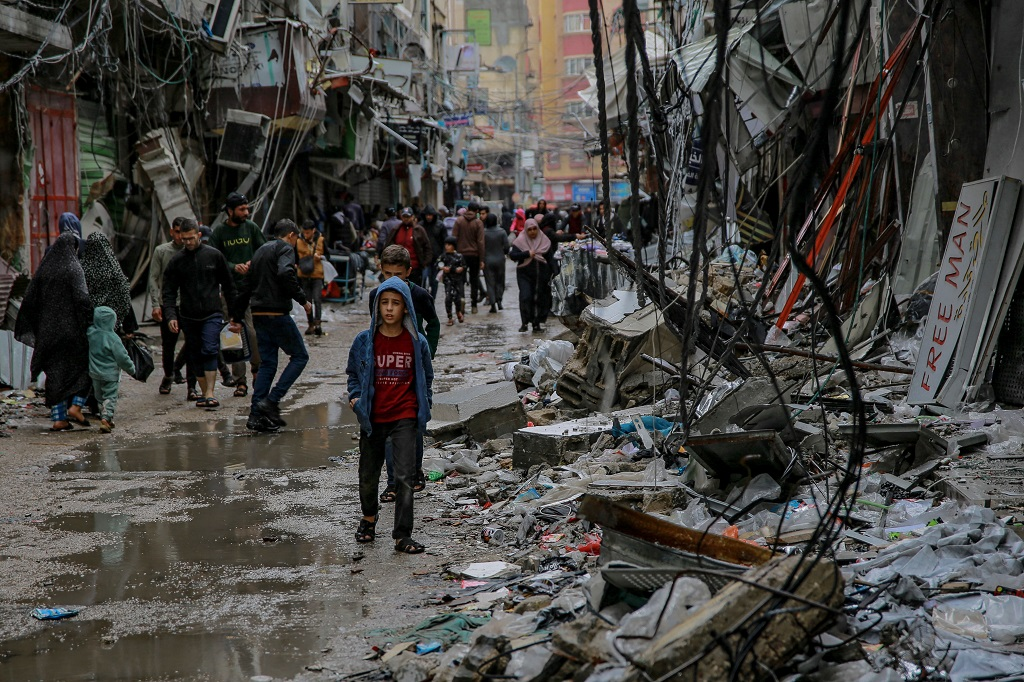
In the Gaza Strip, life has come to a virtual standstill for more than three years, and approximately 2.25 million Palestinians are living with the consequences of a military operation that Hamas and its supporters portrayed as an important chapter in Palestinian history, despite the fact that it was carried out by a group within Hamas rather than through consensus within the movement, as became evident from the consequences of the operation and what followed.
Away from the ongoing debate and the praise coming from Muslim Brotherhood platforms across the region, the consequences of October 7 remain undeniable.
Despite those consequences, there are still those who regard October 7 as a victory, even seeing the world’s focus on the massacres committed by Netanyahu against our people as evidence of that victory.
What is happening today in terms of regional arrangements is moving, in the broader context, in a direction that serves Israel and the United States, through the exploitation of the Muslim Brotherhood as an American project and the use of the “Iranian threat” while allowing Iran to contribute to the weakening of Arab states.
Iran, which described October 7 as an important milestone, contributed through its influence and affiliated forces to the downfall and occupation of Iraq and the exploitation of its resources. At a time when Iran was supposedly under sanctions and pressure, billions of U.S. dollars were flowing from Iraq to Iran, with the United States turning a blind eye.
More importantly, the Iranian and Muslim Brotherhood projects have been reinforced through influential media platforms, most notably Al Mayadeen and Al Jazeera. The former serves as a voice for Iran in the region, while the latter has been closely associated with the Muslim Brotherhood. Both have relied heavily on hostile rhetoric toward Israel and slogans such as “Death to Israel.”
This presentation ultimately feeds a state of polarization that keeps the region preoccupied with these projects, away from the larger question of the future of Arab states and their ability to protect their decisions and resources. As Islamist forces come to dominate the scene at the expense of the national project represented by the state and its institutions, the gap widens, paving the way for political Islam at the expense of the nation-state. Ultimately, this trajectory serves Islamist groups and their projects rather than society and the state as a whole.
This same deception has passed through Arab societies before. History tells us how some once turned to Britain and France to replace the Ottomans, only to discover that replacing one foreign power with another did not mean independence, but rather the reproduction of colonialism in a new form.
The United States did not deal with Iran in the same way it dealt with Iraq. Iran played a significant role in reshaping Iraq’s political and security system after the invasion and expanded its influence considerably, while Iraq’s resources became divided between the United States and Iran. Yet this is often explained simply as a result of Tehran’s strength, without examining the broader nature of the conflict, the space permitted within it, and Tehran’s role in weakening Palestine and the Arab region.
The American equation, is to keep Iran strong enough to pose a burden to Arab states, but weaker than Israel, thereby preserving Israel’s regional superiority. The core of the American-Iranian dispute, therefore, is not preventing Iran from becoming a regional power, but preventing it from acquiring nuclear weapons in a way that preserves Israel’s strategic superiority.
Tehran, which many regard as opposed to the American project, continues to have economic and commercial ties with Israel, directly or indirectly, alongside investments and interests connected to Israel in Iran. Here, another contradiction emerges.
Iran, whose political discourse emphasizes defending Muslims and confronting Israel, is home to approximately 30,000 Jews, with around 200 synagogues in which they worship. At the same time, international estimates and estimates from Sunni circles indicate that Iran has more than 7 million Sunni Iranians, while there is not a single Sunni mosque for them in Iran.
Yet Tehran is still regarded by some as the leader of the region’s liberation movement and as a leading force in defending the Arabs. Some even continue to regard it as the only force confronting occupation and the United States.
 11 Total Count